4% Mandi Fee Raises Costs, Haryana Wheat Industry Faces Mounting Pressure
★ ₹212 Negative Parity as Market Prices Fall Below MSP-Based Cost
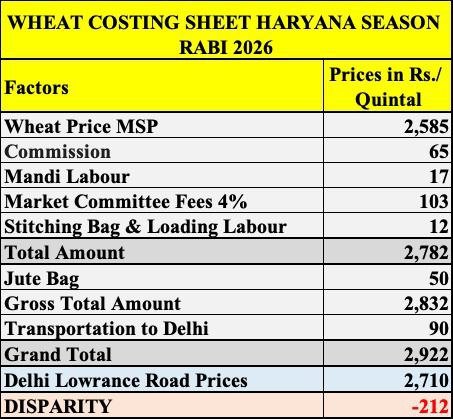
★ The wheat industry in Haryana is facing growing stress in the Rabi 2026 season due to rising costs and weak market prices. The total cost of moving wheat from Haryana to Delhi’s Lawrence Road market stands at ₹2,922 per quintal, while the prevailing market price in Delhi is ₹2,710 per quintal. This has resulted in a negative parity of ₹212 per quintal.
★ Since more than 95% of wheat in Haryana and Punjab is procured by the Food Corporation of India (FCI) at the Minimum Support Price (MSP), the MSP of ₹2,585 per quintal is considered the benchmark. After adding 4% mandi fee (₹103), commission, labour charges, jute bag cost, and transportation to Delhi, the total cost rises to ₹2,922 per quintal. At current market prices, traders face a direct loss.
★ Haryana, one of India’s leading wheat-producing states, levies a 4% mandi fee—significantly higher than other states. Punjab currently has zero mandi fee, Uttar Pradesh charges 1.5%, Uttarakhand 2.5%, and Rajasthan about 2.1%.
★ Industry sources say the higher mandi fee has weakened the competitiveness of Haryana’s milling sector. Several flour mills have either shut down or are on the verge of closure due to rising operational costs.
★ Recent wheat lifting under the FCI’s Open Market Sale Scheme (OMSS) has been strong, indicating that markets in Haryana and ★ Punjab are heavily dependent on government schemes. However, frequent changes in OMSS volumes, conditions, and stock limits have created uncertainty in the market. These policy shifts are affecting procurement strategies of traders and millers, keeping prices under pressure.
★ Despite the government allowing wheat exports, the domestic market has not shown the expected improvement. At current price levels, export parity is also becoming unfavourable, potentially impacting global competitiveness.
★ Industry representatives believe that if the Haryana government wants to safeguard the wheat sector, it must review the 4% mandi fee. A reduction in the fee could lower costs, improve competitiveness, and provide relief to the milling industry.
★ For now, rising costs, falling prices, and policy uncertainty have pushed Haryana’s wheat industry into a challenging phase.